Family Dentistry
When Do Baby Teeth Come In and Fall Out? A Parent's Timeline
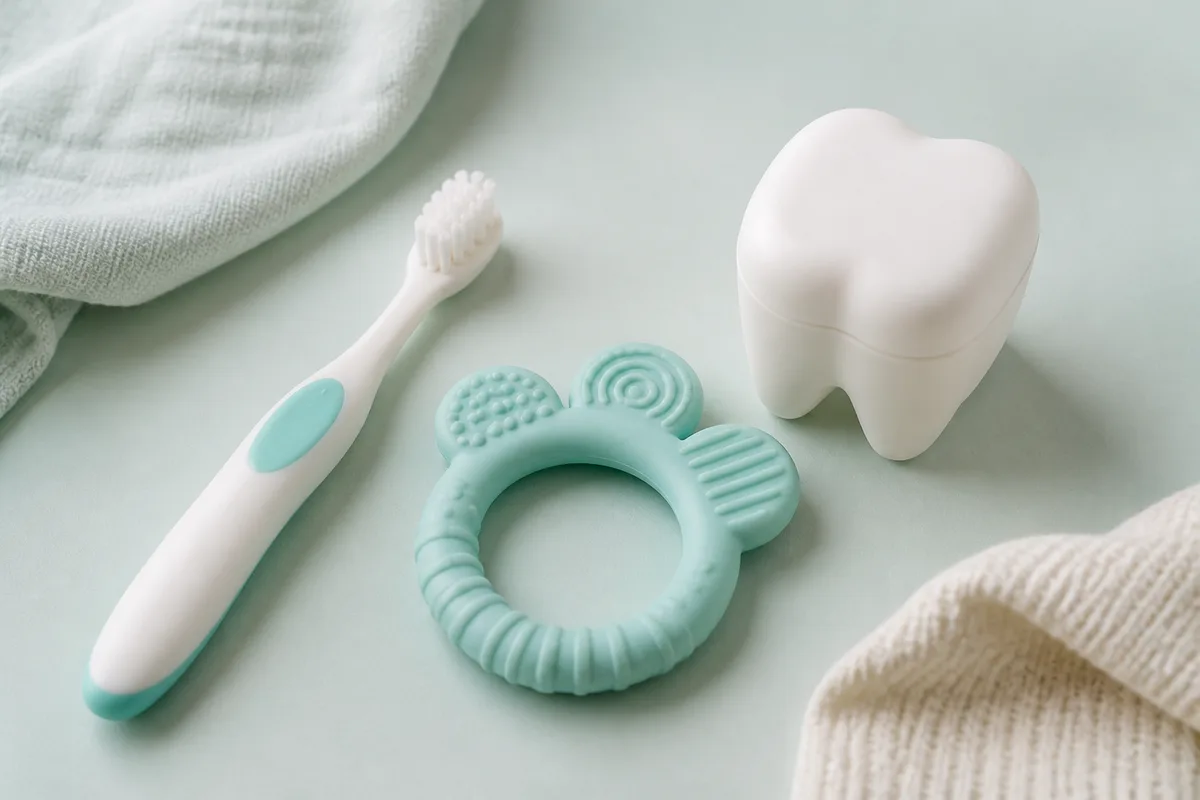
Your friend's baby had four teeth at nine months, and yours is still all gums. Or your six-year-old grins at you with a wobbly front tooth and a brand-new one already poking up behind it. Both moments send parents searching for the same thing: what is normal, and when should I worry?
The reassuring part is that tooth timing varies a lot from child to child. Below is the American Dental Association's timeline for every baby tooth, what helps with teething, and the few situations that do deserve a dental visit.
When do baby teeth come in and fall out?
Short answer: Most babies get their first tooth around 6 months, usually a lower front tooth, and all 20 baby teeth are typically in by about age 3. They start falling out around age 6, beginning with the front teeth, and the last baby molars usually go between ages 10 and 12. A difference of several months either way is normal.
Every baby is born with all 20 baby teeth already developing inside the jaws, 10 on top and 10 on the bottom. They break through the gums in a fairly predictable order, though not on a precise schedule.
Baby teeth chart: when each tooth comes in and falls out
The ranges below come from the ADA's primary teeth eruption chart on MouthHealthy. "Comes in" is the age in months when a tooth typically breaks through the gum. "Falls out" is the age in years when it is typically shed.
| Baby tooth | Upper: comes in | Upper: falls out | Lower: comes in | Lower: falls out |
|---|---|---|---|---|
| Central incisor (front tooth) | 8–12 months | 6–7 years | 6–10 months | 6–7 years |
| Lateral incisor | 9–13 months | 7–8 years | 10–16 months | 7–8 years |
| Canine (cuspid) | 16–22 months | 10–12 years | 17–23 months | 9–12 years |
| First molar | 13–19 months | 9–11 years | 14–18 months | 9–11 years |
| Second molar | 25–33 months | 10–12 years | 23–31 months | 10–12 years |
A few patterns help when you compare the chart with your own child:
- These are typical ranges, not deadlines. A tooth that shows up a few months before or after its range is common and usually means nothing. Early or late teething often runs in families.
- The lower front teeth usually lead. The lower central incisors are typically the first in and among the first out.
- The first molars usually arrive before the canines. That leaves a gap between the front teeth and the molars for a few months, which is expected.
- Teeth often come in pairs, the left and right versions of the same tooth around the same time.
- Teeth tend to fall out in roughly the order they came in, front teeth first and molars last.
Which permanent teeth come in first?
Usually the first permanent molars, often called six-year molars, along with the lower front teeth. The ADA's permanent teeth chart puts the upper and lower first molars at 6–7 years, the same window in which the lower central incisors are replaced.
The detail many parents miss is that the first permanent molars do not replace anything. They come in behind the last baby molar on each side, top and bottom, so no baby tooth falls out to make room for them. Because they arrive quietly, they are easy to mistake for baby teeth. Their chewing surfaces have deep grooves where decay often starts, which is why dental sealants are commonly recommended once they have come in.
The same thing happens again around ages 11 to 13, when the second permanent molars come in behind the first ones. The baby molars, meanwhile, are replaced by premolars, typically between about 10 and 12. Wisdom teeth, if they come in at all, usually appear between 17 and 21.
What are the signs of teething, and what helps?
Teething commonly brings fussiness, trouble sleeping, irritability, a smaller appetite and more drooling than usual. According to the ADA's MouthHealthy teething guide, fever, diarrhea and rash are not normal teething symptoms. They are reasons to call your pediatrician rather than chalk them up to a new tooth.
What helps
- Gently rubbing the gums with a clean finger, a small cool spoon or a moist gauze pad
- A clean teether made of solid rubber, used while you watch so your baby does not choke
- Asking your dentist or pediatrician whenever you are unsure whether a product is safe
What to avoid
- Teething necklaces and bracelets, including amber necklaces. The FDA has received reports of deaths and serious injuries in babies and children, including strangulation and choking, linked to teething jewelry.
- Numbing gels with benzocaine or lidocaine for children under 3. The FDA warns that they offer little or no benefit and carry serious risks. Benzocaine can cause methemoglobinemia, a dangerous drop in how much oxygen the blood can carry.
- Homeopathic teething tablets. The FDA urges parents not to use them, and lab testing has found inconsistent amounts of belladonna, a toxic substance, in them.
- Liquid-filled teething rings and plastic teethers that could break or develop sharp edges.
Benzocaine is the active ingredient in several common over-the-counter mouth-pain products, so check the label before you put anything on a young child's gums.
When is early or late teething worth a dental visit?
Most timing differences are harmless, but a few situations are worth having a dentist look at:
- No teeth by around 12 to 18 months. A toothless first birthday is usually not a concern on its own, and it is a good question to bring to the first dental visit. If there are still no teeth by about 18 months, a dentist can check whether the teeth are forming. Late teething often runs in families, but occasionally it is tied to a medical or developmental condition your pediatrician should know about.
- A tooth at birth or in the first weeks of life. These early teeth are sometimes loose or make nursing uncomfortable, so have them looked at.
- Lopsided timing. If a tooth on one side came in many months ago and its partner on the other side has not appeared, mention it.
- A baby tooth that falls out on its own years early. A toddler or preschooler who loses a tooth without any injury should be seen, since early loss without a clear cause sometimes points to a gum or medical problem.
- A baby tooth that hangs on well past its range, especially if the permanent tooth is coming in crooked beside it.
Why is my child's adult tooth coming in behind the baby tooth?
Because the permanent tooth sometimes breaks through before the baby tooth's root has dissolved enough for it to fall out. This is common, especially with the lower front teeth, and parents often call them "shark teeth" because the child briefly has two rows.
Often the baby tooth loosens and comes out on its own, and the tongue gradually nudges the new tooth forward into line. Gentle wiggling by your child is fine. Have a dentist take a look if the baby tooth is not loose at all, if it is still there a couple of months after the new tooth appeared, or if the area is sore or swollen. Removing a stubborn baby tooth is usually a short visit, and it gives the permanent tooth room to move into place.
What should you do if a baby tooth is knocked out early?
Call a dentist the same day, and do not try to put the tooth back. Replanting a baby tooth can damage the permanent tooth forming in the jaw near its root. Bring the tooth if you find it, since it helps the dentist confirm the whole tooth came out. If you cannot find it, it may have been pushed up into the gum rather than knocked out, which is another reason to have it checked.
The dentist will check the socket, the lip and the neighboring teeth, and talk with you about whether the gap needs a space maintainer to keep the other teeth from drifting. That question comes up more often with back teeth than front ones. Also call if a baby tooth turns gray or dark in the weeks after a fall, since that can mean the nerve was injured.
When to call a dentist right away
- A baby tooth knocked out, pushed out of position or pushed up into the gum
- A broken tooth, especially if you can see pink or red in the center
- Bleeding from the mouth that will not stop with steady, firm pressure from clean gauze
- Swelling of the gum or face, or a pimple-like bump on the gum near a tooth
- Tooth pain that keeps your child from eating or sleeping
Go to the emergency room or call 911 if… your child hit their head and passed out, is vomiting, or seems confused or unusually sleepy; has trouble breathing or swallowing; or has swelling spreading toward the eye or down the neck. Those need hospital care before a dental visit.
For a dental injury without those signs, call us. We keep room for dental emergencies and will get your child seen as quickly as we can — you do not need to be an existing patient.
When should your child first see a dentist?
When the first tooth comes in, and no later than the first birthday. That is the recommendation of the American Academy of Pediatric Dentistry, and in practice it usually means a visit within about six months of that first tooth. The first visit is short and mostly a conversation with you about cleaning, feeding and fluoride. Our guide to when a child should first see a dentist walks through what happens, and our children's dentistry visits are planned around whatever age your child starts.
How much toothpaste should babies and toddlers use?
A smear about the size of a grain of rice from the first tooth until age 3, then a pea-sized amount from 3 to 6. That is the guidance from the ADA and the American Academy of Pediatrics.
- Before any teeth appear, wipe the gums with a clean, damp cloth or gauze pad after feedings.
- Brush twice a day with a small, soft-bristled brush. You do the brushing at first, then supervise as your child learns.
- Once two teeth touch, start cleaning between them with floss.
- Teach your child to spit out the toothpaste rather than swallow it.
- Do not put your child to bed with a bottle of anything but water.
Baby teeth matter even though they fall out. They hold space for the permanent teeth, and the back molars stay until about age 10 to 12, so decay in them has years to cause trouble. Our article on why cavities in baby teeth still matter explains more, and if a thumb or pacifier is part of the picture, see how those habits affect teeth.
Questions to ask at your child's next dental visit
- Are my child's teeth coming in on a normal schedule for their age?
- Are the spacing and bite developing the way you would expect?
- Do you see any early white spots we should work on at home?
- Is my child getting the right amount of fluoride, and would fluoride varnish help?
- When should we plan sealants for the six-year molars?
- Is there a habit, like a pacifier or a bedtime bottle, we should change now?
Whether your child is cutting a first tooth or losing a fifth, we are glad to take a look. Rio Hondo Dental Office is at 8514 Paramount Blvd. in Downey, and our team speaks English and Spanish. As a family dental office, we can often see parents and children in the same trip. Call (562) 928-5559 or request an appointment.
Have questions about your smile?
Dr. Sameer Aljanedi and the team at Rio Hondo Dental Office are here to help. Se habla español.