Oral Health
Vaping, Smoking and Your Gums: What Actually Happens in Your Mouth
Maybe you have noticed that your gums hardly ever bleed when you floss, even though you smoke, and you have taken that as a good sign. Or you switched from cigarettes to a vape a couple of years ago and assume your mouth is in the clear now. Both are reasonable guesses, and both can be wrong in ways that do not hurt until a tooth starts to feel loose.
This guide covers what tobacco and nicotine actually do to the gums, what is known and still unknown about vaping, what gets better after you quit and what to ask at your next visit. It is not a lecture. Plenty of people who smoke or vape already want to stop, and knowing what is happening in your mouth can be one more reason to try.
How does smoking affect your gums?
Short answer: Smoking is a major risk factor for gum disease. The CDC says smokers have twice the risk of nonsmokers, and the risk climbs the more and the longer you smoke. Smoking weakens the body's response to gum infection, slows healing and can reduce gum bleeding, which hides the main early warning sign. Gum treatment also tends to work less well until you quit.
Gum disease starts as gingivitis, inflammation caused by bacteria in plaque and tartar. Left alone, it can become periodontitis: pockets open between gum and tooth, and the bone holding the teeth breaks down until they loosen. The CDC's page on smoking, gum disease and tooth loss explains that smoking weakens the immune system's ability to fight a gum infection and makes damaged gums harder to heal. It also notes that tobacco in any form, including pipes and smokeless tobacco, raises the risk.
In practice, smokers tend to develop more severe gum disease, lose more bone around their teeth and lose more teeth over a lifetime than people who have never smoked.
Why smokers' gums may not bleed, and why that is a problem
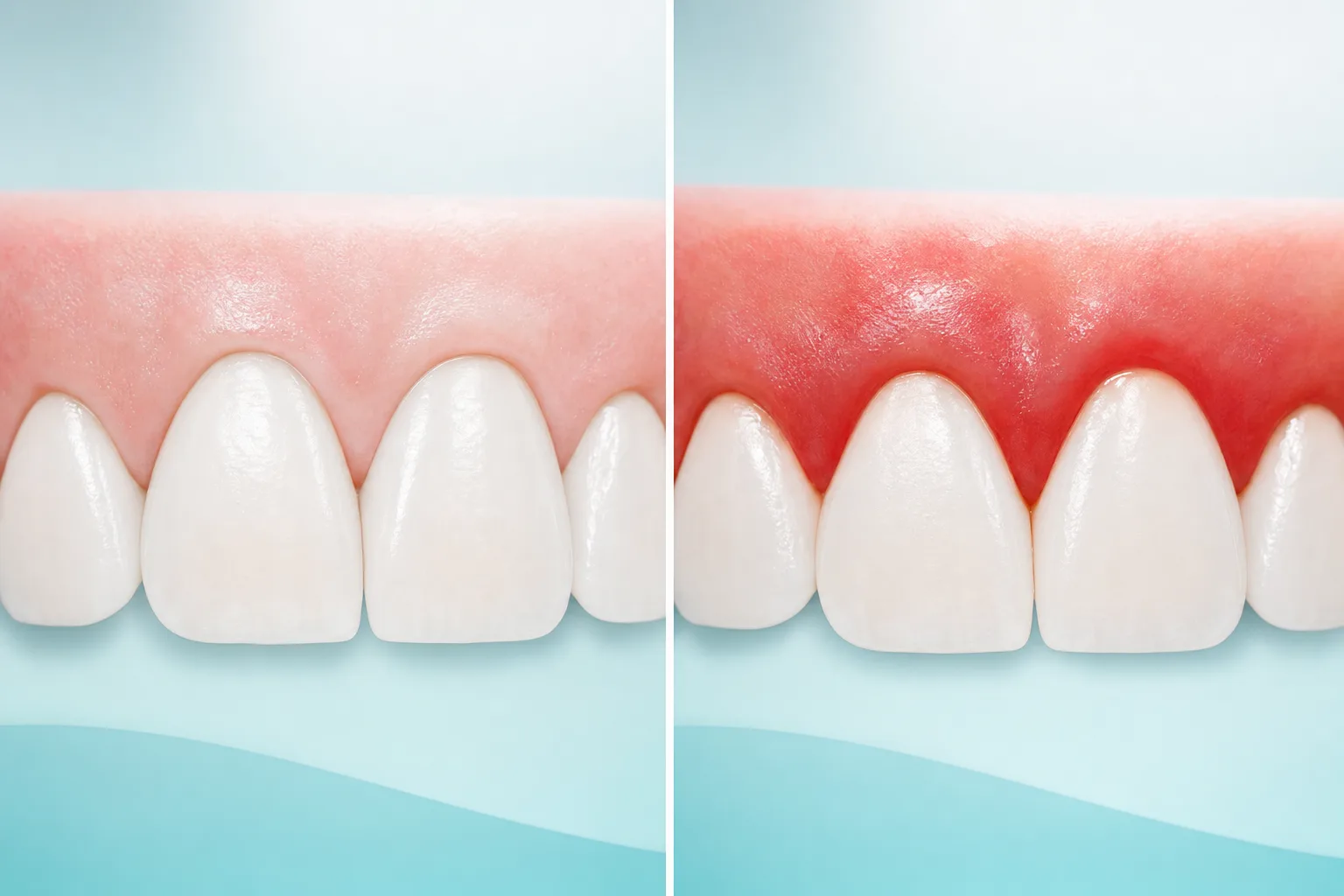
Nicotine narrows blood vessels, including the small ones in the gums, so a smoker's gums often bleed less and can look pale and firm rather than red and puffy, even while infection is working below the gumline. That is a problem because bleeding when you brush or floss is the first sign of gum disease most people notice. The usual alarm does not go off.
That is how someone who smokes can feel completely fine and still have measurable bone loss. The reliable way to know is a gum exam: the dentist or hygienist measures the pocket around each tooth with a small probe and compares bone levels on X-rays. If you smoke and nobody has measured your gum pockets recently, ask for it. Our gum disease treatment page explains what those numbers mean and what treatment involves.
Does smoking slow healing after dental work?
Yes. Reduced blood flow and a weaker immune response affect almost any procedure that has to heal:
- Extractions. After a tooth is removed, a blood clot forms in the socket and protects the bone underneath. Smoking raises the risk that the clot breaks down or comes loose, leaving a painful condition called dry socket. The suction of drawing on a cigarette or vape is thought to add to the problem. Ask your dentist how long to avoid smoking before and after; the longer, the better.
- Gum treatment. Deep cleaning and gum surgery generally bring smaller improvements in people who keep smoking. The CDC notes that quitting helps gums heal after treatment.
- Dental implants. An implant has to fuse with the jawbone and then stay surrounded by healthy gum and bone for years. Smokers have a higher risk both of implants that fail to fuse and of infection around implants later on. Smoking does not automatically rule out dental implants, but it is part of the planning conversation, and stopping before surgery and through healing is generally advised.
What smoking does to your teeth, breath and taste
Tobacco stains enamel yellow or brown. A professional teeth cleaning removes much of the surface stain, but whitening tends not to work as well or last as long in people who keep smoking. Smoking also dulls taste and smell, reduces saliva and causes a stale breath that mints only mask for a short while. Less saliva brings its own cavity risk, which our guide to dry mouth explains.
Does smoking raise your risk of oral cancer?
Yes. Tobacco use is one of the main causes of cancers of the mouth and throat, and drinking alcohol on top of smoking raises the risk further. Cigars, pipes and smokeless tobacco carry risk too. Have any of these checked if they last longer than two weeks:
- A sore, ulcer or rough spot that does not heal
- A white or red patch on the gums, tongue, cheek or floor of the mouth
- A lump or thickening in the cheek or neck
- Hoarseness, trouble chewing or swallowing, or numbness in the mouth that does not go away
Most of these turn out to be something harmless, but only an exam can tell. An oral cancer screening is a quick look-and-feel check of the lips, tongue, cheeks, throat and neck. If you use any form of tobacco, it is worth having at every checkup.
Is vaping better for your gums than smoking?
Nobody can say yet with confidence. E-cigarettes have not been widely used for long enough to show what decades of vaping do to the mouth, and the ADA's MouthHealthy page on vaping says plainly that the facts on vaping and dental health are still incomplete.
What is reasonably well known
- Nicotine is still nicotine. Most vape liquids contain it, and even some cartridges labeled nicotine-free have been found to contain some. It narrows blood vessels whatever delivers it, so it may affect the gums' blood supply in a similar way.
- Dry mouth is common. Many people who vape report a dry mouth, and less saliva means more plaque and a higher risk of cavities.
- The aerosol is not just water vapor. Researchers have found harmful substances in vape cartridges, including chemicals known to cause cancer, heavy metals such as nickel and lead, and fine particles. Many flavorings also contain sugar.
What is still uncertain
- Gum disease. Early studies have found signs of more gum inflammation in people who vape than in people who use no nicotine, but many of these studies are small and short, and many vapers used to smoke, which makes it hard to tell which habit caused what.
- Cavities. A study in the Journal of the American Dental Association found an association between vaping and untreated cavities, but more research is needed to know whether vaping actually causes them.
- Long-term risk compared with cigarettes. Vape aerosol contains fewer chemicals than cigarette smoke, but fewer is not the same as safe, and the long-term effects on the gums and on oral cancer risk are not yet known.
If you vape, the practical advice is the same as for smoking: mention it at every visit, have your gums measured, and watch for dryness, bleeding or gums that seem to be pulling back.
What does chewing tobacco do to your gums?
Chewing tobacco, snuff and dip sit against the same patch of gum for hours, and the damage tends to show up right there. The gum in that spot can recede, exposing the root, which becomes sensitive and decays more easily. Many users also develop a white, wrinkled or leathery patch where they hold the tobacco, and some of these patches can turn into cancer over time. Some products also contain sugar and grit that feed decay and wear down teeth.
Receded gum does not grow back on its own, though it can often be treated. Our guide to gum recession causes, warning signs and treatment options explains what can be done. Nicotine pouches, many of which contain no tobacco leaf, are also held against the gum. There is little long-term research on them yet, so mention them to your dentist too.
What improves after you quit?
A lot, and some of it sooner than people expect. Over the following weeks and months:
- Blood flow to the gums recovers. Your gums may actually bleed more at first when you brush. That is usually returning circulation unmasking inflammation that was already there, not new damage, and it is a good reason to book a cleaning and a gum check.
- Gum treatment works better, and the gums heal more readily afterward.
- Taste, smell and breath improve, and new staining stops building up.
- Healing after extractions, gum procedures and implant surgery becomes more predictable.
Over the longer term, the risk of gum disease and of oral cancer keeps falling the longer you stay quit. The honest limit is that quitting stops further harm but does not regrow bone or gum that has already been lost. Existing pockets and recession still need treatment and regular maintenance, which is one more reason to start sooner rather than later.
Where can you get help quitting?
You do not have to do it alone, and much of the help is free:
- Call 1-800-QUIT-NOW for free, confidential coaching through a quitline. The CDC also lists 1-855-DÉJELO-YA for help in Spanish. 1-800-QUIT-NOW also helps people who want to stop vaping.
- Ask about medicines. Nicotine patches, gum and lozenges are sold over the counter, and prescription pills such as varenicline and bupropion are available through your physician. Pairing a patch with a short-acting form such as gum or a lozenge can improve your chances compared with using one alone.
- Use counseling and medicine together. The CDC's guide to quitting smoking says the combination gives people the best chance of quitting for good.
- Expect setbacks. Many people need more than one attempt. A slip is a reason to adjust the plan, not to give up.
If you moved from cigarettes to vaping to cut down, tell your dentist and your physician. That is useful information, not a confession, and they can help you work toward the next step.
When to see a dentist soon
Book a visit promptly, rather than waiting for your next routine checkup, if you notice:
- Gums that bleed, look swollen or have started to pull away from the teeth
- A tooth that feels loose, or a bite that suddenly feels different
- A sore, white patch or red patch in the mouth that has not healed in two weeks
- Pain that gets worse a few days after an extraction instead of better, especially with a bad taste or an empty-looking socket
- A swelling or pimple-like bump on the gum, which can be an abscess. Swelling that spreads toward the eye or neck, fever with facial swelling, or any trouble breathing or swallowing means the emergency room, right away.
Questions to ask at your next dental visit
- Have my gum pockets been measured, and how do they compare with last time?
- Do my X-rays show any bone loss around my teeth?
- Is there any gum recession, and is it getting worse?
- Did my oral cancer screening show anything you want to keep an eye on?
- Given that I smoke or vape, how often should I come in for cleanings?
- If I need an extraction or an implant, how long should I stop smoking before and after?
You do not need to have quit before you come in, and nobody here will lecture you. Rio Hondo Dental Office is at 8514 Paramount Blvd. in Downey, and our team speaks English and Spanish. Call (562) 928-5559 or request an appointment, and tell us what you smoke, vape or chew so we can check your gums, set your cleaning schedule and do your screening with that in mind.
Have questions about your smile?
Dr. Sameer Aljanedi and the team at Rio Hondo Dental Office are here to help. Se habla español.